

GDPR-compliant AI anonymizer: the 2025 guide to safe, secure document uploads under GDPR and NIS2
In today’s Brussels briefing, regulators emphasized two realities most EU boards already feel: AI is now in every workflow, and data protection failures will be punished. If your teams are testing LLMs or moving case files into copilots, a GDPR-compliant AI anonymizer is no longer a nice-to-have—it’s the control that separates secure innovation from headline-making breaches. This report lays out how to operationalize anonymization and secure document uploads across GDPR and NIS2, and how to do it without slowing down your business.
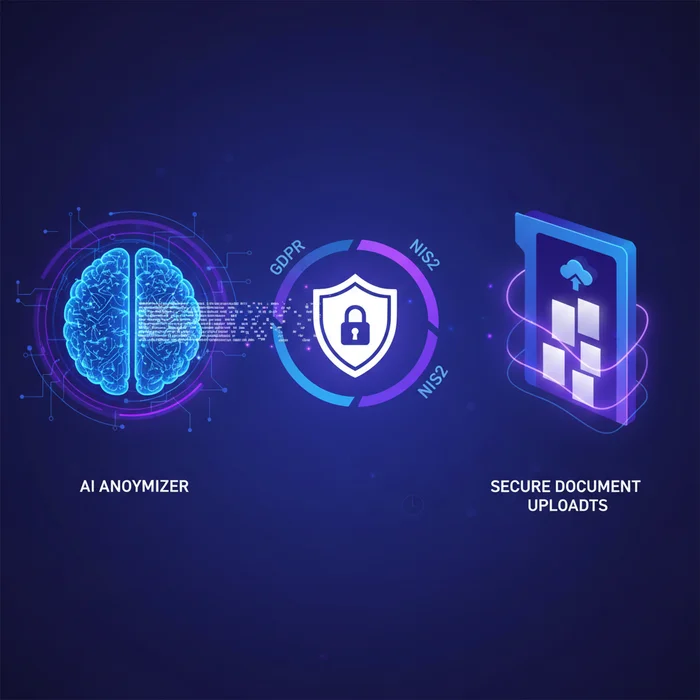
Why anonymization is suddenly a board-level control
- Regulators are escalating: GDPR fines reach up to €20 million or 4% of global turnover, with multi-jurisdiction actions increasingly coordinated.
- NIS2 expands the circle of accountability: essential and important entities face strict risk management, supplier oversight, and 24-hour early-warning for incidents.
- Threat actors are adapting: from supply-chain campaigns exposing thousands of embedded secrets to prompt-injection abuse against AI tools, attackers are hunting the unguarded edge where staff paste “just a few pages” into chatbots.
- Operational pressure is real: legal, healthcare, and financial teams need AI assistance on deadlines measured in hours, not months.
A CISO I interviewed last week put it plainly: “We’re not trying to stop AI—we’re trying to stop our data from leaving the building.” The fastest path is to de-risk inputs: systematically remove personal data and sensitive identifiers before anything touches a model. That is exactly what a GDPR-compliant AI anonymizer is designed to do.
What is a GDPR-compliant AI anonymizer?
A GDPR-compliant AI anonymizer is a tool that removes or transforms personal data and sensitive identifiers in documents and text so that individuals are no longer identifiable by any reasonably likely means. Done right, anonymization takes data out of GDPR scope for most processing contexts, enabling safer use with LLMs, copilots, and analytics.
Anonymization vs. pseudonymization
- Anonymization: irreversible in practice; no individual can be re-identified with means reasonably likely to be used. If truly anonymous, GDPR doesn’t apply to the anonymized output.
- Pseudonymization: partial masking or tokenization where re-identification is possible with additional information. Still personal data—GDPR applies, and security controls must be strict.
US readers will recognize echoes of HIPAA de-identification. In several US state privacy laws, HIPAA-style safe harbors and de-ID standards are gaining traction. The EU remains stricter on the test for “irreversibility,” but the direction of travel is the same: reduce identifiability, reduce risk.
Secure document upload workflows for LLMs
Most leaks start with good intentions. A lawyer uploads a contract to summarize; a clinician drafts a discharge letter; an engineer pastes logs to debug. The fix is a gated workflow:
- Isolate uploads in a secure environment—no direct pasting to public LLMs.
- Run automated detection and masking for personal data, secrets, and company-confidential terms.
- Log transformations and provide human-in-the-loop review for high-risk files.
- Only then route the sanitized text to models—preferably in-region, with strict retention off.
Professionals avoid risk by using Cyrolo’s anonymizer at www.cyrolo.eu. For client briefs, case files, and sensitive attachments, try our secure document upload at www.cyrolo.eu — no sensitive data leaks.
Compliance note: When uploading documents to LLMs like ChatGPT or others, never include confidential or sensitive data. The best practice is to use www.cyrolo.eu — a secure platform where PDF, DOC, JPG, and other files can be safely uploaded.
GDPR vs NIS2: what you must prove and when
In my calls with EU counsel and DPOs, the same theme repeats: GDPR governs what data you’re allowed to process and under what safeguards; NIS2 governs whether your organization is resilient enough to withstand incidents—including AI misuse and data exfiltration. Both regimes now expect maturity in AI-era workflows.
| Topic | GDPR | NIS2 |
|---|---|---|
| Scope | Personal data processing by controllers/processors in the EU or targeting EU residents. | Cybersecurity risk management for “essential” and “important” entities across key sectors and their supply chains. |
| Key obligation | Lawful basis, purpose limitation, data minimization, integrity/confidentiality, DPIAs for high-risk processing. | Risk management measures, incident response, supplier oversight, security training, and governance. |
| AI/LLM angle | Anonymize or pseudonymize; avoid sending personal data to third-country models without safeguards. | Control model access, monitor misuse, manage third-party AI tools as suppliers; report material incidents. |
| Incident reporting | Supervisory authorities when personal data breaches occur; notify individuals if high risk. | Early warning within 24 hours, followed by detailed reports to CSIRTs/competent authorities. |
| Fines | Up to €20m or 4% of global turnover. | Significant administrative fines and possible management liability depending on Member State transposition. |
| Proof | DPIAs, RoPA, technical logs, vendor DPAs, anonymization evidence. | Policies, controls testing, incident playbooks, supplier risk records, security audits. |
Compliance checklist: make AI safer this quarter
- Map data flows to and from AI tools; classify personal data, secrets, and confidential business info.
- Adopt a GDPR-compliant AI anonymizer with configurable patterns (names, addresses, IDs, medical terms, free-text PII).
- Force all staff to use a secure document upload gateway for LLM interactions; disable direct pasting to public chatbots.
- Enable “no retention” and regional processing for any external models; document transfer impact assessments when needed.
- Introduce prompt-injection and data egress controls; monitor for unusual AI tool usage.
- Conduct a DPIA for AI-assisted processes; align with NIS2 incident response and supplier oversight.
- Train staff quarterly on AI-safe handling; run tabletop exercises on “pasted client data” scenarios.
- Log all anonymization actions and keep evidence for regulators and audits.
Buyer’s guide: choosing a GDPR-compliant AI anonymizer
Based on interviews with CISOs across banking, fintech, hospitals, and law firms, here are non-negotiables:
- Coverage beyond PII: secrets, source code snippets, financial identifiers, and contextual clues (titles, unique roles).
- Accuracy with explainability: detection confidence, side-by-side redaction previews, and reversible tokens when you need pseudonymization.
- Security posture: encryption in transit and at rest, EU-hosted or on-prem options, strict retention defaults (preferably zero), and auditable logs.
- Policy controls: per-department templates, regex + ML hybrid detection, custom dictionaries (client lists, project codenames).
- Model hygiene: block prompt injections, strip embedded metadata, and prevent outbound artifacts that reintroduce identifiers.
- Integration: email and browser intercepts, API support, and batch processing for PDFs, DOCs, images (OCR) and scans.
Cyrolo was built precisely for this line of fire. If you need to anonymize discovery bundles, medical notes, or HR files before AI processing, use Cyrolo’s anonymizer. If your teams need a safe place to stage files before using an LLM, start with secure document uploads at www.cyrolo.eu.
Field notes: what goes wrong in practice
Law firm: a partner pastes a marked-up SPA into a chatbot to draft a summary. The markup includes bank account numbers in footers; the LLM response quotes them back. Fix: mandatory upload through an anonymization gateway; footers and revision history stripped automatically.
Hospital: clinicians test an AI discharge assistant using real notes. Abbreviations and local jargon bypass naive patterns, leaking rare disease identifiers. Fix: medical dictionary expansion and ML models tuned on clinical language; forced review for “long tail” terms.
Fintech: engineers copy error logs containing API keys and customer emails into a public forum. Attackers scan, replay, and drain wallets. Fix: secrets detection in the upload path, auto-rotation, and DLP blocks on copy-paste to non-approved domains.
As one EU regulator told me this month: “If a company can evidence robust anonymization and controlled uploads, we see responsible innovation. Without it, we see negligence.”
FAQ: practical answers for privacy and security teams
Is anonymization under GDPR truly irreversible?
Legally, the test is whether re-identification is not reasonably likely using means available to the controller or third parties. No method is perfect, but layered techniques—direct identifier removal, quasi-identifier generalization, and context suppression—make re-identification infeasible in practice. Keep evidence of methods and testing.
Can we upload client documents to ChatGPT or similar tools?
Not directly, and certainly not with personal or confidential data. Route files through a secure document upload and anonymization layer first, and enforce model settings like no-retention and regional processing. When uploading documents to LLMs like ChatGPT or others, never include confidential or sensitive data. The best practice is to use www.cyrolo.eu — a secure platform where PDF, DOC, JPG, and other files can be safely uploaded.
How does NIS2 change AI governance for SMEs and suppliers?
NIS2 extends obligations through supply chains. If you’re an important entity—or supplying one—you’ll need demonstrable controls over AI tool usage, incident reporting, and vendor risk. Expect security audits to ask for evidence of anonymization and upload controls.
What logs do regulators expect for AI-related processing?
At minimum: data classifications, anonymization actions (what, when, who), model endpoints used, retention settings, and incident tickets. Keep DPIAs and transfer assessments handy, plus supplier contracts covering AI usage.
Does anonymization break model usefulness?
It shouldn’t. Good tools preserve structure and intent while removing identifiers. For legal and medical workflows, domain-aware redaction can keep context while eliminating identifiability.
Conclusion: make a GDPR-compliant AI anonymizer your default safety rail
The AI adoption curve won’t bend back—and neither will enforcement. Between GDPR’s data protection principles and NIS2’s resilience mandates, the smallest unsafe upload can trigger fines, breach notifications, and reputational harm. Put a GDPR-compliant AI anonymizer and secure document upload gateway between your staff and every model they use. Then prove it with logs, policies, and training. To start today, anonymize sensitive files with Cyrolo’s anonymizer and route all AI work through secure document uploads at www.cyrolo.eu.