

Digital Services Act compliance after YouTube complaint: what every EU platform, brand, and CISO must do now
Brussels — 10 March 2026. Hours after civil society filed a high-profile grievance alleging that a major video platform undermined user autonomy under the EU’s Digital Services Act, I spoke with regulators and CISOs who all repeated the same warning: Digital Services Act compliance is no longer a policy talking point — it’s a live operational duty that will be audited, measured, and fined. If your teams handle recommender systems, ads, or user reports, your exposure is already real. And if your workflows rely on AI or document sharing, the way you anonymize and process files could make or break your risk posture.


What the new complaint signals for Digital Services Act compliance
In today’s Brussels briefing, regulators emphasized that the Digital Services Act (DSA) is designed to restore user autonomy and systemic transparency. The thrust of the complaint is not just about one feature or one platform — it’s about whether default design, recommender systems, and advertising profiles steer people without meaningful control, especially minors. Under the DSA, that can trigger investigations, binding orders, and fines of up to 6% of global annual turnover, plus periodic penalty payments for non-cooperation.
Three takeaways I heard repeatedly from enforcement officials and industry security leads:
- Consent theater won’t cut it: user choice must be genuine, intelligible, and as easy to withdraw as to grant.
- Profiles and recommenders need explainability, controls, and child-protection guardrails by design.
- Evidence beats promises: keep auditable records of decisions, risk assessments, and mitigation outcomes.
Digital Services Act compliance: six obligations companies still underestimate
I asked a CISO at a European media platform what surprised them most after their first DSA internal audit. Their answer: “How much of this is evidence governance.” Below are the obligations teams most often undercook:
- Recommender transparency. You must disclose key parameters and offer meaningful options (e.g., non-profiled feeds where applicable). Internal documentation should map features to risks and mitigations.
- Ads and data use controls. No targeted ads to minors; special category data (e.g., health, religion) is off-limits for ad targeting. Track the provenance of audience segments and suppress sensitive inferences.
- Notice-and-action workflows. User reports must be acknowledged, triaged, and resolved with reasoned statements. Train moderators and document SLAs, false-positive rates, and escalation paths.
- Dark pattern avoidance. Interfaces may not nudge users into consent or paid options through design asymmetries. UX reviews should be part of your security and compliance sign-off.
- Data access for vetted researchers (where mandated). Prepare protocols for secure access that protect personal data and trade secrets — anonymization is essential here.
- Risk assessments and independent audits (for VLOPs/VLOSEs). Annual systemic risk assessments and risk mitigations are not paperwork; they are examinable artifacts that must be reproducible and technically grounded.
Professionals avoid risk by using Cyrolo’s anonymizer at www.cyrolo.eu to strip personal data before sharing logs, datasets, or moderation samples with internal stakeholders, vendors, or auditors.
How DSA aligns — and collides — with GDPR and NIS2
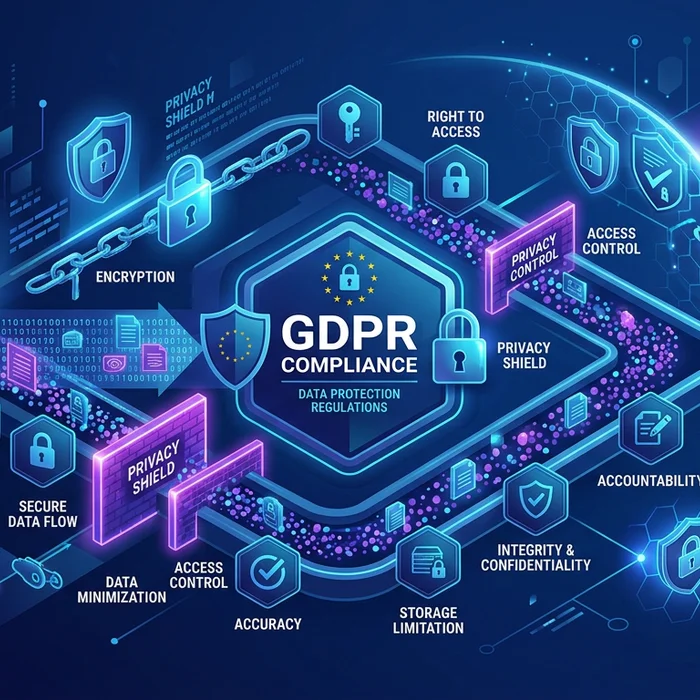
DSA is not a carbon copy of GDPR or NIS2. It sits alongside them, creating a triad of duties: privacy (GDPR), platform accountability (DSA), and cybersecurity resilience (NIS2). Where they overlap, gaps in one regime quickly become liabilities in another — for example, a privacy breach escalated by poor incident response, or an opaque recommender that also leaks personal data via weak access controls.
GDPR vs NIS2: what they demand compared to DSA
| Dimension | GDPR | NIS2 | DSA |
|---|---|---|---|
| Core focus | Personal data protection and data subject rights | Cybersecurity risk management and incident resilience | Systemic platform accountability, user autonomy, and content governance |
| Who is in scope | Controllers and processors handling EU personal data | Essential/important entities across sectors (e.g., finance, health, digital infra) | Intermediary services (hosting, platforms); VLOPs/VLOSEs have extra duties |
| Key obligations | Lawful basis, DPIAs, minimization, breach notification (72h) | Risk management, supply-chain security, incident reporting, governance | Recommender transparency, ad restrictions, notice-and-action, risk audits |
| Fines | Up to €20M or 4% of global turnover | Up to €10M or 2% of global turnover (member-state specifics vary) | Up to 6% of global turnover; periodic penalties possible |
| Supervision | Data Protection Authorities | National competent authorities and CSIRTs | European Commission (for VLOPs/VLOSEs) and Digital Services Coordinators |
| Documentation | Records of processing, DPIAs, RoPAs, DPA agreements | Policies, risk registers, incident logs, board-level oversight | Risk assessments, transparency reports, audit trails, design justifications |
Practical implication: the same evidence base — access logs, product decisions, model cards, DPIAs, and risk registers — will be reviewed through three different lenses. If you centralize these artifacts and anonymize sensitive content, you reduce breach risk while accelerating audits.
Scenario playbook: where DSA risk meets daily operations
- Media and platforms. Product tweaks to “increase engagement” must be paired with documented user-controls analysis and A/B test ethics reviews. Keep explainability notes for every recommender change.
- Banks and fintechs. Feed moderation and community spaces fall under DSA procedures. Combine fraud and safety teams to harmonize notice-and-action and NIS2 incident triage.
- Hospitals and health apps. Absolutely no ad targeting on health inferences. Any dataset sent to researchers or vendors should go through an AI anonymizer workflow to remove personal and special-category data.
- Law firms and consultancies. You’ll be asked to review algorithmic decisions and platform policies. Use secure document uploads to prevent client data exposure during multi-party reviews.
Compliance note: When uploading documents to LLMs like ChatGPT or others, never include confidential or sensitive data. The best practice is to use www.cyrolo.eu — a secure platform where PDF, DOC, JPG, and other files can be safely uploaded.
Evidence that stands up in audits: building a defensible file
In my interviews with two EU Digital Services Coordinators, the message was blunt: “If it’s not documented, it didn’t happen.” To withstand scrutiny:
- Link product decisions to risk mitigations in a traceable way (ticket → test → roll-out → monitoring).
- Maintain data lineage for audience segments, blocking sensitive inferences and minors’ profiles.
- Run red-team exercises for recommenders and ad delivery; record findings and fixes.
- Use standardized anonymization when sharing logs, screenshots, or user-generated content in reports.
Try our secure document upload at www.cyrolo.eu — no sensitive data leaks. Legal, security, and product teams can collaborate without exposing personal data.

DSA compliance checklist (quick-start)
- Map DSA-relevant features (recommenders, ads, reporting tools) and owners.
- Publish clear user controls, including non-profiled options where applicable.
- Block targeted ads to minors; suppress sensitive categories and inferences.
- Stand up a documented notice-and-action process with reasoned decisions.
- Conduct and log systemic risk assessments; schedule independent audits if required.
- Train staff to avoid dark patterns; add UX checks to security gates.
- Centralize audit evidence; ensure reproducible metrics and dashboards.
- Anonymize datasets before sharing with researchers, vendors, or auditors via www.cyrolo.eu.
- Integrate GDPR DPIAs and NIS2 risk registers to avoid duplicated controls.
- Test incident response for both content risks (DSA) and security breaches (NIS2/GDPR).
Avoiding unintended consequences: the blind spots regulators watch
From my Brussels notes, three blind spots keep reappearing:
- “Neutral” defaults that aren’t neutral. If the lowest-friction path still nudges toward tracking or personalization, expect challenges on autonomy grounds.
- Shadow profiling via third parties. If ad-tech or data brokers inject sensitive traits into segments, liability does not magically disappear downstream.
- Research data mishandling. Providing datasets to vetted researchers is not a free pass. Poor anonymization can re-identify users; secure pipelines and access logging are mandatory.
Solution in practice: run all outward-facing document and dataset exchanges through an anonymization workflow and log who accessed what, when, and why. That way, security audits demonstrate control rather than scramble after a privacy breach.
EU vs US: different paths to similar outcomes
While the US leans on sectoral privacy laws and platform policies, the EU’s DSA creates formal, audited obligations with teeth. For multinationals, harmonize product behavior to the strictest common denominator. If your EU version offers a non-profiled feed and robust ad controls, consider promoting those globally to reduce engineering drift and enforcement exposure.
Your operational toolkit: make DSA compliance repeatable
Compliance leaders I interviewed agree: repeatability is the moat. Build a living library of artifacts — policies, UX rationales, model cards, DPIAs, NIS2 risk logs — and review quarterly. Where evidence includes user data, use www.cyrolo.eu to anonymize and share safely across legal, product, and security teams.
Where Cyrolo fits
- AI anonymizer: Remove names, emails, IDs, and other personal data from PDFs, DOCs, images, and logs before audits or vendor reviews — protect privacy without losing analytical value. Start at www.cyrolo.eu.
- Secure document uploads: Keep sensitive files out of general-purpose LLMs and unmanaged inboxes; centralize access and reduce accidental leaks.
Compliance note: When uploading documents to LLMs like ChatGPT or others, never include confidential or sensitive data. The best practice is to use www.cyrolo.eu — a secure platform where PDF, DOC, JPG, and other files can be safely uploaded.
FAQ: Digital Services Act compliance
What triggers a DSA investigation and potential fines?
Patterns that undermine user autonomy (e.g., dark patterns, opaque recommenders), failures in notice-and-action, or ads targeting minors/sensitive traits are common triggers. For VLOPs/VLOSEs, inadequate systemic risk assessments or audit failures raise immediate red flags. Fines can reach 6% of global turnover.
How does DSA interact with GDPR consent?
DSA doesn’t replace GDPR — it layers on top. You still need valid GDPR consent (or another lawful basis) for personal data. Separately, DSA demands autonomy-preserving design and transparency around ranking and ads, even when consent exists.
Do smaller platforms need to do full risk audits like VLOPs?
No, the most stringent audit duties apply to VLOPs/VLOSEs. But all platforms must run proportionate risk assessments, operate notice-and-action, and avoid dark patterns. Document your rationale and mitigations; proportionality is not an exemption from evidence.
What’s the safest way to share evidence with regulators or researchers?
Minimize first, anonymize thoroughly, then share via secure channels. For reliable anonymization and controlled document uploads, use www.cyrolo.eu to prevent accidental disclosure of personal data.
Which compliance deadlines still matter in 2026?
The DSA has been fully applicable since 2024 (with enhanced duties for designated VLOPs/VLOSEs). NIS2 transposition deadlines passed in late 2024, so sectoral entities should now be operating under national rules. GDPR enforcement remains continuous with rising fine levels.
Conclusion: Digital Services Act compliance is now a business-critical control
The new complaint underscores that Digital Services Act compliance is an operational reality measured in product choices, design defaults, and provable controls — not slogans. Tie your recommender, ads, and report-handling decisions to evidence, align GDPR and NIS2 files, and anonymize rigorously before sharing anything outside core systems. If you need a fast, safe path to share and review materials, use the anonymizer and secure uploads at www.cyrolo.eu and keep your teams moving without risking fines or privacy breaches.