

GDPR and NIS2 compliance in 2025: Enforcement heat, AI risks, and stress-tested workflows
From Brussels to boardrooms, 2025 is the year when GDPR and NIS2 compliance stops being a policy slide and becomes an operational muscle. In today’s Brussels briefing, regulators emphasized maturity over checklists, while recent court actions and botnet reports underscored a blunt reality: privacy and security are now fused. If your data flows through AI, vendors, or cloud pipelines, you’re exposed. The fastest wins I’m seeing on the ground come from tightening breach reporting, hardening third-party access, and deploying an AI anonymizer and secure document uploads to avoid accidental disclosure—tools you can try at www.cyrolo.eu.
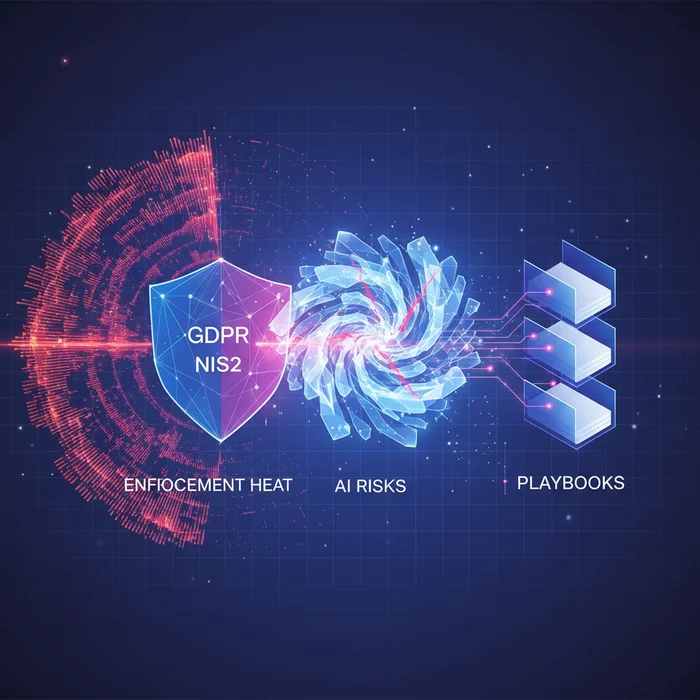
What changed in 2025: Brussels signals sharper oversight
In closed-door conversations this week, EU officials reiterated that “paper compliance” won’t cut it. The EDPB’s enforcement focus (as privacy leaders heard in multiple industry briefings) is shifting toward practical proof: can you demonstrate that risk-based controls actually reduce exposure? Meanwhile, a Spanish court’s decision to uphold GDPR penalties over unfair ad practices reminds us that legacy adtech stacks are still leaking personal data—and courts will call it out.
Two additional forces are tightening the screws:
- NIS2 transposition deadlines are real: Member States are finalizing national laws. Expect scrutiny on incident reporting discipline (24-hour early warning under NIS2, then 72-hour notification, and a final report in one month), leadership accountability, and supply-chain security.
- Operational threats are getting louder: New botnets abusing AI/ML infrastructure and browser notification C2 tactics show how quickly attackers pivot. CISOs I interviewed warn that GPU clusters, LLM gateways, and browser-based messaging APIs are now prime footholds for lateral movement.
Zooming out, EU policy is diverging from the US conversation, where proposals to preempt state AI rules are gaining steam. EU regulators are moving in the opposite direction: preserving granular obligations with sector specificity and auditability. That means your EU posture needs more than a “global” privacy policy—it needs verifiable controls per system and per vendor.
GDPR and NIS2 compliance: where companies stumble
Across banks, hospitals, fintechs, and law firms, I keep seeing the same failure modes:
- Incident reporting clocks: Teams confuse GDPR’s “72 hours from awareness” with NIS2’s staged timeline (24-hour early warning, 72-hour notification). Mixing the two costs precious hours.
- Vendor sprawl: Controllers under GDPR and essential/important entities under NIS2 lack a single inventory of third-party processors, sub-processors, and critical suppliers—leading to blind spots during incidents.
- LLM and AI workflows: Employees paste personal data, contracts, or health details into AI tools without anonymization, creating uncontrolled data transfers and potential privacy breaches.
- DPIAs that stop at analysis: Risk findings aren’t translated into technical safeguards (tokenization, redaction, access boundaries). Regulators are asking to see the “so what.”
- Leadership accountability under NIS2: Boards sign policies but can’t show training, exercises, or decision logs—especially on when to invoke incident reporting.
- Security audits without data mapping: You can’t protect what you can’t locate. Data maps remain outdated and don’t reflect new AI or data lake pipelines.
GDPR vs NIS2: what actually changes for your program
| Topic | GDPR | NIS2 | Who it applies to |
|---|---|---|---|
| Core focus | Personal data protection, data subject rights, lawful processing | Network and information systems security, resilience, incident response | GDPR: controllers/processors of personal data; NIS2: essential/important entities in sectors like finance, health, energy, digital infrastructure, MSPs |
| Reporting deadlines | Notify supervisory authority within 72 hours of becoming aware of a personal data breach | Early warning within 24 hours; incident notification within 72 hours; final report within one month | GDPR: any controller; NIS2: in-scope entities |
| Fines | Up to €20M or 4% of global annual turnover (whichever is higher) | Up to €10M or 2% (essential entities) and up to €7M or 1.4% (important entities), subject to national transposition | Regulator-specific under national law for NIS2 |
| Governance | DPO independence, DPIAs, records of processing | Management accountability, risk management measures, security policies, exercises | Board-level responsibility emphasized under NIS2 |
| Supply chain | Processor contracts (Art. 28), international transfers | Security in supply chains, managed services oversight, auditing critical suppliers | Evidence of due diligence expected |
| AI and data minimization | Lawfulness, data minimization, purpose limitation; DPIAs for high risk | Secure-by-design and by-default, monitoring, logging, incident handling | Technical and organizational measures must be demonstrable |
A practical GDPR and NIS2 compliance checklist
- Map your data and systems: identify personal data flows, critical services, and AI/LLM touchpoints.
- Harden incident reporting: build a single playbook that satisfies GDPR’s 72-hour and NIS2’s 24/72/30-day cadence.
- Stand up an anonymization guardrail: automatically redact or tokenize personal data before any AI or vendor upload using an AI anonymizer.
- Vet vendors by scenario: require breach notification clocks, log export, sub-processor transparency, and data residency options.
- Exercise the board: run a 2-hour tabletop on a dual GDPR+NIS2 breach, including the decision log for notification thresholds.
- Modernize DPIAs: tie risks to specific controls (e.g., conditional access, field-level encryption, secrets rotation, prompt/response redaction).
- Close logging gaps: centralize and retain security logs for detection, notification evidence, and regulator inquiries.
- Train for safe AI: define what can never be pasted into an LLM and enforce with technical controls and secure document workflows.
AI, anonymization, and secure document workflows
The ugliest breaches in 2025 are quiet: a staffer uploads a patient chart to an AI chatbot; a paralegal pastes a draft contract with personal data into a model; an engineer shares a production log containing access tokens. I’ve seen hospitals and law firms stumble here, and regulators are paying attention. One recent case making the rounds involved alleged sharing of sensitive health information through an AI bot—a stark reminder that “helpful” automation can become a privacy incident overnight.

The fix is both cultural and technical: anonymize by default, and make secure upload the only easy path. Professionals avoid risk by using Cyrolo’s anonymizer at www.cyrolo.eu. And when you must share for analysis or collaboration, try our secure document upload at www.cyrolo.eu — no sensitive data leaks.
Compliance note: When uploading documents to LLMs like ChatGPT or others, never include confidential or sensitive data. The best practice is to use www.cyrolo.eu — a secure platform where PDF, DOC, JPG, and other files can be safely uploaded.
How Cyrolo fits your control framework
- Data minimization in practice: Automatic redaction and anonymization before content leaves your environment supports GDPR’s minimization principle and reduces breach impact under NIS2.
- Evidence on demand: Activity logs and consistent workflows help you demonstrate due diligence during audits, security inspections, or regulator queries.
- Vendor containment: Secure document uploads reduce exposure to uncontrolled third-party tools and shadow IT.
- Faster incident triage: If an incident occurs, pre-anonymized data narrows the scope and can influence notification decisions and impact assessments.
Case files from the field
- Banking and fintech: A payments scale-up I spoke with mapped a dual timeline: GDPR breach triage in 0–24 hours, NIS2 early warning by hour 24 if service continuity is at risk, and a combined 72-hour package for both privacy and service regulators. They automated evidence collection from SIEM, DLP, and ticketing to avoid last-minute scrambles.
- Hospitals: After a near-miss involving staff pasting triage notes into a chatbot, a university hospital rolled out anonymization for all AI interactions and restricted uploads to a secure portal. Clinician productivity remained high, but risk plummeted.
- Law firms: A top-tier firm introduced client-mandated “no raw PII into AI” clauses and routed case files through a secure document reader with redaction. Their DPO told me it transformed DPIA conversations from theoretical to demonstrably safer workflows.
FAQ: your search-style questions answered
What’s the difference between GDPR and NIS2 in practice?
GDPR focuses on personal data protection and rights. NIS2 focuses on the cybersecurity and resilience of essential and important services. Many organizations must meet both: protect personal data and keep critical systems resilient, with clear, timed incident reporting.
Does NIS2 apply if my company is outside the EU?
Yes, if you provide in-scope services into the EU or operate EU entities. Jurisdiction can arise through subsidiaries or by offering services to the EU market. Expect local transposition details to define regulators and penalties.
How fast must I report an incident under NIS2?
Provide an early warning within 24 hours, a more complete notification within 72 hours, and a final report within one month. Keep a decision log—regulators are asking how and when you concluded an incident was notifiable.
Can I upload personal data to ChatGPT or other AI tools?
Best practice is no: never upload confidential or sensitive data to public LLMs. Use anonymization and controlled environments. Try secure document uploads and redaction at www.cyrolo.eu.
What is an AI anonymizer and why does it matter?
An AI anonymizer automatically removes or masks personal and sensitive information before content is processed by AI or shared externally. It reduces breach impact, supports GDPR’s minimization principle, and lowers NIS2 risk.
Conclusion: In 2025, GDPR and NIS2 compliance means secure-by-default AI and documents
EU regulators are searching for proof that your controls work—across privacy, security, and AI workflows. The fastest, highest-impact improvements I’ve seen are simple: map your data, align breach clocks, and build anonymization plus secure document uploads into everyday work. To reduce risk and show real-world maturity, start with Cyrolo’s anonymizer and document workflows at www.cyrolo.eu. That’s how GDPR and NIS2 compliance becomes muscle memory—before an incident puts you on the clock.