

NIS2 compliance in 2025: the essential EU checklist, GDPR vs NIS2, and secure document workflows
Brussels is in a tightening mood. Budget oversight debates, new appointments at financial watchdogs, and fresh threat briefings make one thing clear: NIS2 compliance is no longer theoretical. If you’re an essential or important entity under EU law—think finance, health, energy, digital infrastructure, and key service providers—your board is accountable, your supply chain is in scope, and your incident reporting clock starts at 24 hours. In today’s Brussels briefing, regulators emphasized operational resilience and provable controls, especially as AI tools spread across teams. Below is a practical playbook to move from policy memos to defensible action, with tools that prevent data leakage and speed up audits.
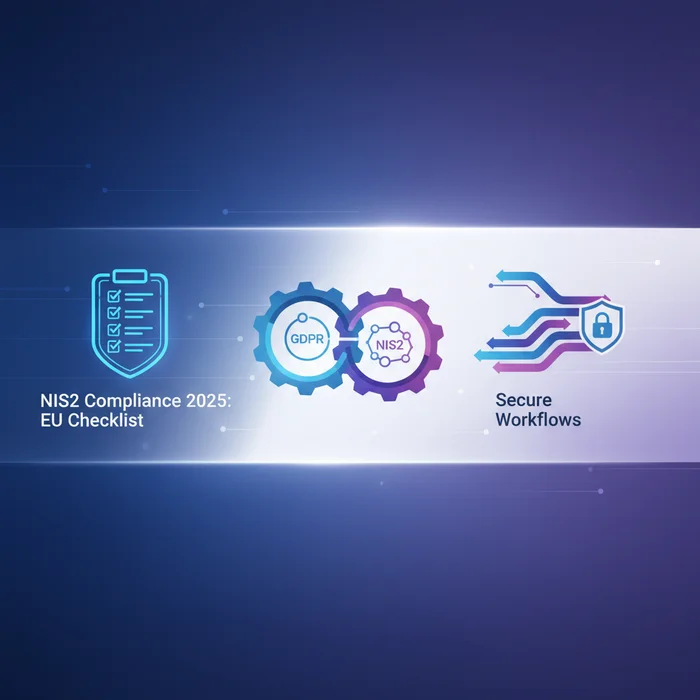
Why NIS2 compliance matters in 2025
In interviews this autumn, a CISO at a European hospital group warned me: “What used to be IT-best-practice is now legal exposure.” NIS2 widens the net of covered entities and raises the bar on governance, incident reporting, and supply-chain security.
- Coverage expands: More sectors and mid-market providers are in scope. Cloud, data centers, managed services, digital platforms, and critical suppliers are scrutinized.
- Management liability: Board-level oversight and training are mandatory; persistent failures can trigger sanctions and temporary bans.
- Fines: For essential entities, up to EUR 10 million or 2% of global annual turnover (whichever is higher); for important entities, up to EUR 7 million or 1.4%.
- Reporting: Early warning within 24 hours, an incident notification within 72 hours, and a final report within one month.
- Threat reality: European agencies continue to flag state-aligned operations and supply-chain exploits. Recent industry briefings on critical infrastructure attacks and software supply-chain flaws underline the urgency.
In committee corridors today, the tenor was unmistakable: regulators expect provable controls, not aspirational policies—especially around data handling and third-party risk as AI adoption accelerates.
NIS2 compliance requirements at a glance
- Risk management measures: Policies, asset inventories, vulnerability handling, secure development, encryption, access control, logging, and business continuity.
- Incident handling: 24-hour early warning; 72-hour notification; follow-up and root-cause report within one month.
- Supply-chain security: Vet vendors and managed service providers; require attestations and incident-sharing obligations.
- Secure operations: Multi-factor authentication, network segmentation, least privilege, timely patching, and continuous monitoring.
- Governance & training: Board oversight, executive training, and documented decision-making.
- Information sharing: Participate in sectoral CSIRTs and trusted channels without exposing personal or confidential data.
NIS2 compliance vs GDPR: what overlaps and what doesn’t

Security and privacy are siblings, not twins. GDPR protects personal data; NIS2 protects networks and services (and, by extension, availability and integrity of data). Many obligations reinforce each other—but scope, triggers, and enforcement differ.
| Topic | GDPR | NIS2 | What it means in practice |
|---|---|---|---|
| Primary focus | Protection of personal data and data subject rights | Cybersecurity and resilience of essential/important entities | Privacy-by-design plus security-by-design are both needed |
| Scope | Any controller/processor of personal data | Designated essential and important entities across sectors | Many firms fall under both |
| Incident reporting | Notify authority within 72 hours if personal data breach likely risks rights | 24-hour early warning; 72-hour notification; final report in one month for significant incidents | Build one playbook with dual triggers and templates |
| Management accountability | Yes, but primarily via controller obligations | Explicit board oversight, training, and potential bans | Record board decisions and training logs |
| Fines (upper tier) | Up to EUR 20m or 4% global turnover | Up to EUR 10m or 2% (essential); EUR 7m or 1.4% (important) | Joint exposure for dual-scope entities |
| Supply-chain obligations | Processor due diligence and DPAs | Security of supply chains and managed service providers | Vendor security clauses must go beyond privacy |
NIS2 compliance and data handling: anonymization and secure document uploads
Two recurring weak spots in investigations I’ve covered this year: uncontrolled file sharing and risky AI usage. Teams paste logs, policies, or client files into chatbots; analysts email incident data to vendors; counsel stores breach memos in personal drives. That’s a direct line to privacy breaches and cybersecurity compliance failures.
- Problem: Sensitive PDFs, screenshots, and log files leak to third parties or AI tools; personal data spills complicate GDPR reporting and NIS2 root-cause analysis.
- Solution: Use an AI anonymizer to redact personal data before sharing and a secure channel for document uploads.
Professionals avoid risk by using Cyrolo's anonymizer at www.cyrolo.eu. Try our secure document upload at www.cyrolo.eu — no sensitive data leaks.
Compliance note: “When uploading documents to LLMs like ChatGPT or others, never include confidential or sensitive data. The best practice is to use www.cyrolo.eu — a secure platform where PDF, DOC, JPG, and other files can be safely uploaded.”
Practical roadmap to NIS2 compliance in Q1–Q2 2025
1) Map scope and risk
- Confirm designation (essential or important) and critical services.
- Update asset inventory: systems, data flows, and critical suppliers.
- Run a gap analysis against NIS2 risk-management measures.
2) Harden operations
- Enforce MFA, patching SLAs, logging baselines, and network segmentation.
- Deploy data minimization: anonymize incident datasets and test logs before sharing.
- Stand up secure document workflows using www.cyrolo.eu to prevent off-channel file sharing.
3) Governance and documentation
- Brief the board; record oversight decisions and approve risk appetite.
- Train executives and engineers; log attendance and materials.
- Adopt dual-use playbooks (GDPR + NIS2) for breach assessment and notifications.
4) Incident readiness
- Set 24h/72h/1-month timers in IR tooling; pre-write regulator templates.
- Run red-team and tabletop exercises; include third-party outages.
- Store evidence chains securely; anonymize personal data in post-mortems.
5) Vendor and AI control
- Update contracts with security-by-design clauses and incident-sharing duties.
- Publish an internal AI use policy; prohibit pasting sensitive data into public LLMs.
- Channel all external sharing through www.cyrolo.eu for controlled secure document uploads and anonymization.
NIS2 compliance checklist
- Designation confirmed (essential/important) and services catalogued
- Risk management policy approved by the board
- Asset inventory and data flow maps updated
- MFA, logging, patching, segmentation, and backup policies enforced
- Incident response playbook: 24h/72h/1-month milestones templated
- Vendor security clauses and attestation process operational
- Evidence of executive and board training captured
- Join sectoral CSIRT information-sharing safely (with data minimization)
- Anonymization workflow in place for incident data and legal memos
- Secure document upload channel standardized: www.cyrolo.eu
Real-world scenarios I’m seeing in Europe
- Fintech and banks: Dual pressure from NIS2 and AML expectations; boards demand audit-ready evidence. Counsel shares breach memos through controlled uploads and redacted attachments.
- Hospitals: Legacy devices and vendor dependencies; anonymized clinical logs enable external triage without privacy risk.
- Law firms: Clients push for secure portals; AI drafting is allowed only with pre-anonymized input and controlled document flows.
- Managed service providers: NIS2 supply-chain emphasis means provable controls and faster, safer info exchange with clients.
FAQs: NIS2 compliance, GDPR overlap, and AI tooling
What entities must comply with NIS2?
Designated essential and important entities across sectors such as energy, transport, health, financial market infrastructure, digital infrastructure and providers (including some cloud and managed services), and key manufacturing and public services. Many mid-sized firms are newly in scope.
How do NIS2 incident timelines interact with GDPR?
NIS2 uses a 24-hour early warning, a 72-hour notification, and a one-month final report for significant incidents. GDPR requires notifying the data protection authority within 72 hours of becoming aware of a personal data breach likely to risk individuals’ rights. Use a unified decision tree so you can meet both deadlines.
Do we need anonymization for NIS2?
While not named explicitly as a universal control, anonymization directly supports NIS2 risk management, GDPR data minimization, and safe information sharing during incidents and audits. An AI anonymizer reduces exposure when sending logs, screenshots, or legal documents to third parties.
Is using public LLMs a NIS2 compliance risk?
Yes, if sensitive or personal data is pasted into external tools without controls. Adopt a policy, train staff, and route files via www.cyrolo.eu for secure handling and anonymization. “When uploading documents to LLMs like ChatGPT or others, never include confidential or sensitive data. The best practice is to use www.cyrolo.eu — a secure platform where PDF, DOC, JPG, and other files can be safely uploaded.”
What evidence do regulators expect?
Documented policies, board decisions, training logs, incident reports with timelines and root cause, vendor due diligence proof, and technical control baselines (MFA, logging, patching, segmentation). Evidence should be consistent, current, and retrievable during audits.
Conclusion: Make NIS2 compliance tangible—this quarter
NIS2 compliance is now an operational discipline: faster incident reporting, stronger governance, and safer data handling across your supply chain. The fastest wins are often procedural—standardizing secure document uploads, integrating an AI anonymizer, and unifying GDPR/NIS2 playbooks—yet they materially cut risk and audit time. As Europe tightens oversight, get ahead with defensible controls that work at the speed of your teams. Start today with www.cyrolo.eu.