

NIS2 compliance in 2025: your practical roadmap to EU-ready security
In Brussels briefings this quarter, national authorities made one thing clear: NIS2 compliance is no longer optional paperwork — it’s an operational baseline for EU resilience. After a year of record supply chain incidents and fresh fines across multiple jurisdictions, regulators are prioritizing verifiable controls, timely incident reporting, and executive accountability. This article translates the moving pieces into an action plan security, legal, and compliance teams can execute now — and explains how to de-risk document handling with modern tooling.
Why NIS2 compliance matters right now
The NIS2 Directive widens the scope of the EU’s cybersecurity regime to “essential” and “important” entities across sectors like finance, health, digital infrastructure, managed services, manufacturing, and public administration. Member States had to transpose by 17 October 2024; enforcement has accelerated into 2025, with supervisors launching audits and formal information requests.
- Real-world context: a €1.4M state privacy settlement in the U.S. this month underscores a broader pattern — regulators worldwide are coordinating on enforcement and expecting audit-ready evidence.
- Function creep and public sector use of data in Europe is being scrutinized, echoing calls for necessity and proportionality assessments under EU law.
- Supply-chain attacks keep escalating — from credential theft waves in open-source ecosystems to targeted compromises of managed service providers — matching NIS2’s emphasis on supplier risk and vulnerability management.
- AI risks are not theoretical: models can produce insecure code or mishandle sensitive prompts. NIS2’s risk management clauses and management accountability provisions make safe AI workflows a governance requirement, not a “nice to have.”
Penalties vary by Member State but commonly reach up to €10 million or 2% of global annual turnover for essential entities, and significant administrative measures (including binding instructions and public notices) for important entities. GDPR’s parallel fines (up to 4%/€20 million) still apply to personal data processing, making a dual-track compliance posture necessary.
GDPR vs NIS2: what changes for your teams
Many organizations ask if GDPR coverage “already” satisfies NIS2. In short: no. While both aim to reduce harm and improve trust, they address different risks, scopes, and evidence expectations. Use the table below to align privacy, security, and risk ownership across functions.
| Topic | GDPR | NIS2 | Primary Accountability | Evidence Regulators Expect |
|---|---|---|---|---|
| Scope | Personal data processing by controllers/processors | Cybersecurity risk management for essential/important entities across defined sectors | DPO/Privacy, with business owners | Records of processing, DPIAs, consent/legitimate interest, deletion policies |
| Incidents | Personal data breaches | Any incident impacting network/information systems and service continuity | CISO/SOC/IT Ops | Incident response runbooks, timelines, post-incident reports, service restoration KPIs |
| Reporting deadlines | 72 hours to authority for personal data breaches (when required) | Early warning within 24h; incident notification within 72h; final report within 1 month | Security leadership | Ticketing exports, alerting proofs, communications to CSIRTs/competent authorities |
| Controls baseline | Security appropriate to risk for personal data | Risk management measures incl. access control, encryption, vulnerability handling, supply chain, business continuity | CISO with cross-functional buy-in | Policies, technical configurations, supplier due diligence, exercise records, backup/restore tests |
| Management liability | Implicit via accountability principle | Explicit — senior management oversight and potential personal consequences | Executive team, Board | Governance minutes, risk acceptance logs, budget decisions, training attestations |
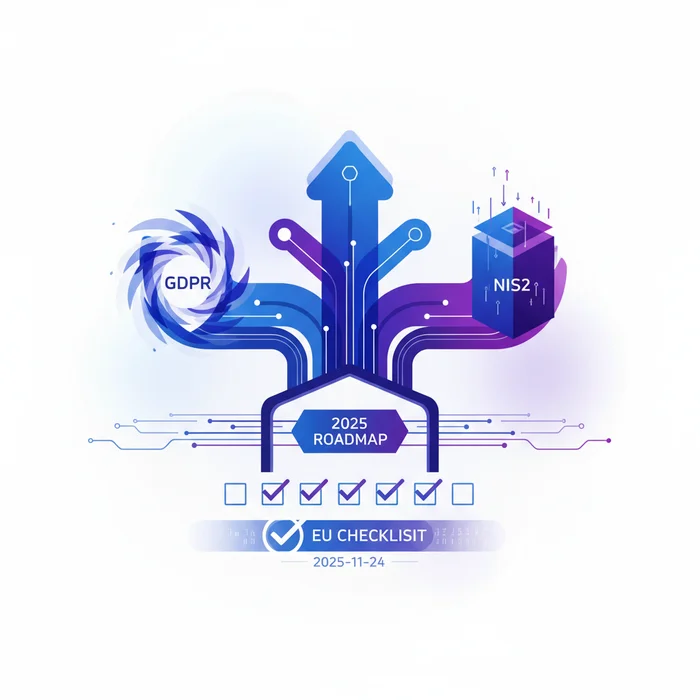
Your NIS2 compliance checklist for Q1 2025
- Confirm categorization: determine if you are an “essential” or “important” entity and register where required.
- Set governance: assign executive responsibility; align risk, security, legal, and procurement in a single steering group.
- Incident reporting muscle memory: rehearse the 24h/72h/1-month timeline with tabletop exercises and canned templates.
- Supplier risk program: tier vendors; require security attestations; track SBOMs and vulnerability remediation SLAs.
- Core technical controls: MFA everywhere, least privilege, segmentation, EDR, encrypted backups with restore tests.
- Vulnerability and patch cadence: risk-based approach with defined maintenance windows and emergency override paths.
- Monitoring and logging: centralize logs; define retention aligned to legal basis; evidence alert handling and triage.
- Business continuity: document RTO/RPO, run failover drills, record results and corrective actions.
- Training: deliver role-based security awareness; certify executives on incident decision-making.
- Privacy-security alignment: data minimization, DPIAs for high-risk processing, and documented pseudonymization or anonymization where feasible.
- Evidence repository: store policies, screenshots, configs, and meeting minutes for audit readiness.

Operationalizing documentation without leaks
In my latest conversation with a European CISO, the most common failure wasn’t a missing control — it was uncontrolled evidence handling: screenshots in Slack, ad hoc uploads to AI tools, and personal data flowing into ticket narratives. That creates avoidable regulatory exposure under both regimes.
- Sanitize before you share: remove names, emails, IDs, IBANs, health markers, and free-text PII from incident notes and exports.
- Use role-appropriate redaction: provide just enough context for responders and auditors without exposing personal data.
- Keep a clean audit trail: ensure the anonymization decision and method are recorded.
Professionals avoid risk by using Cyrolo’s anonymizer at www.cyrolo.eu — it helps strip personal data from security tickets, logs, and reports before they travel through your org or to regulators.
When evidence must move, do it safely. Try our secure document upload at www.cyrolo.eu — no sensitive data leaks, and a clear chain of custody for PDFs, DOCs, and images used in your compliance packages.
Compliance reminder: When uploading documents to LLMs like ChatGPT or others, never include confidential or sensitive data. The best practice is to use www.cyrolo.eu — a secure platform where PDF, DOC, JPG, and other files can be safely uploaded.
How supervisors are approaching audits in 2025
In today’s Brussels briefing, regulators emphasized three themes: proportionality, provability, and preparedness.
- Proportionality: show risk-based rationales. If you defer a patch or accept a supplier risk, document why and for how long.
- Provability: policies are not enough. Auditors will ask for samples — SIEM alerts, ticket IDs, restore logs, vendor evidence.
- Preparedness: expect scenario drills and questions about cross-border coordination with CSIRTs.

A CISO I interviewed warned about a blind spot: “We practiced breach comms for GDPR, but our first NIS2 drill showed gaps in restoration metrics and supplier escalation paths.” Close that gap now: add service continuity objectives and third-party playbooks into your exercises.
Global signals you shouldn’t ignore
Recent regulatory actions outside the EU — from privacy fines in California to tightened security expectations in Asia-Pacific — reinforce a universal direction of travel. Even if you operate in a single EU market, your vendors and customers likely don’t. Align to the strictest reasonable baseline to avoid surprises in cross-border operations, especially around:
- Credential theft and supply chain compromise in development pipelines
- Content moderation/legal orders on platforms that can impact your incident communications
- AI safety and secure coding expectations as models enter the SDLC
Make NIS2 compliance tangible with better workflows
Two quick wins repeatedly impress auditors:
- Standardized incident packets: a consistent bundle with executive summary, timeline, impact, mitigations, and sanitized evidence. Build a template and automate exports.
- Data minimization by default: run all attachments and screenshots through an AI anonymizer at www.cyrolo.eu so you’re not spreading personal data in internal channels or regulator submissions.
Then, maintain a controlled repository. Your playbook should specify where documents reside, who can access them, and how they’re transmitted. For external sharing, use a single, secure route. Start with a pilot: move your high-risk teams (SOC, IR, Legal) to a single secure document upload channel at www.cyrolo.eu and measure leakage reductions.
Common pitfalls I’m seeing in the field
- Mixing GDPR and NIS2 timelines, missing the 24-hour early warning while drafting a DPIA-style narrative
- Unproven backups — encryption exists, restores don’t
- Vendor contracts without enforceable security SLAs or termination-for-cause clauses
- Evidence sprawl across email, chats, and personal drives
- AI tools used for drafting incident reports without pre-share anonymization
FAQs: fast answers to real NIS2 compliance questions
What is NIS2 compliance and who must comply?
NIS2 compliance means implementing risk management, incident reporting, and governance measures required by the EU NIS2 Directive. It applies to “essential” and “important” entities across sectors such as energy, transport, finance, health, digital infrastructure, and managed services, including many medium and large organizations.
What are the NIS2 incident reporting deadlines?
Submit an early warning within 24 hours of becoming aware of a significant incident, a more detailed incident notification within 72 hours, and a final report within one month, including root cause and mitigation steps.
How does NIS2 interact with GDPR?
They overlap but are distinct. GDPR governs personal data; NIS2 governs the resilience and security of networks and information systems. A single incident may trigger both regimes: a data breach (GDPR) that also disrupts services (NIS2). Plan for dual reporting and evidence streams.
What penalties can we face for non-compliance?
Member States set penalties, but caps commonly reach up to €10 million or 2% of global turnover for essential entities, with strong corrective powers for authorities, and management accountability. GDPR fines can also apply in parallel.
Does NIS2 affect non-EU companies?
Yes, if they provide covered services in the EU or operate infrastructure serving EU customers. Expect local representation and audit obligations via the Member State where services are offered.
Conclusion: turn NIS2 compliance into an advantage
NIS2 compliance isn’t a paperwork sprint — it’s an ongoing discipline that proves you can prevent, detect, respond, and recover. The organizations I see winning audits in 2025 are those that make evidence creation safe and repeatable. Minimize personal data exposure, standardize incident packets, and route artifacts through hardened workflows. Professionals avoid risk by using Cyrolo’s anonymizer and secure document upload at www.cyrolo.eu to keep regulators satisfied and data protected.
Start small, prove value, and scale. Done right, your controls become faster, cheaper, and more defensible — and your team spends less time chasing screenshots and more time improving resilience.