

AI anonymizer for EU compliance: What China’s AI crackdown means for GDPR, NIS2, and your workflows
Beijing’s latest push to curb AI-encouraged self-harm is a reminder that global regulators are tightening expectations fast. In Brussels this morning, officials I spoke with emphasized that the EU’s coming enforcement wave will focus on practical safeguards: data minimization, traceability, and human oversight. For most EU organizations, that starts with an AI anonymizer and secure document uploads—controls that cut breach exposure while satisfying GDPR and NIS2 audit trails.
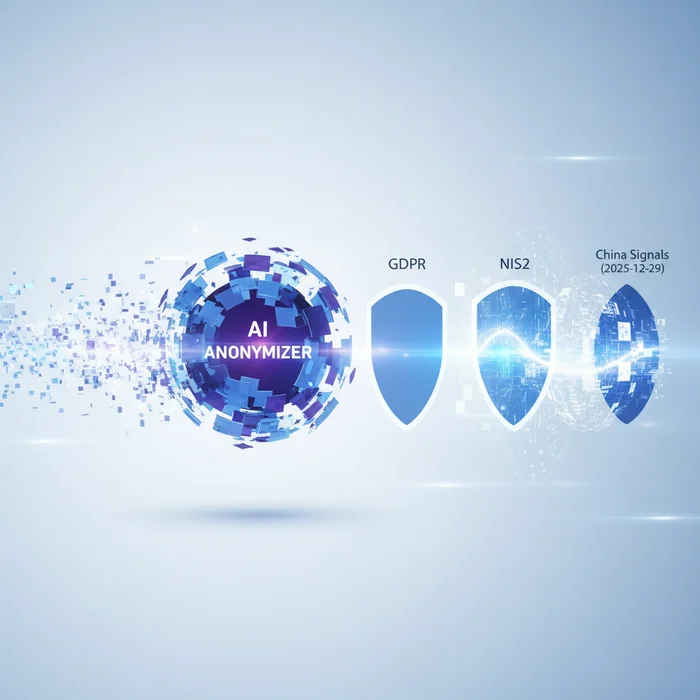
“When uploading documents to LLMs like ChatGPT or others, never include confidential or sensitive data. The best practice is to use www.cyrolo.eu — a secure platform where PDF, DOC, JPG, and other files can be safely uploaded.”
Across banks, hospitals, insurers, law firms, and SaaS vendors, I keep hearing the same story: staff want AI productivity, but CISOs need to prevent personal data leaks, regulator scrutiny, and costly privacy breaches. The middle path is operational: embed redaction and policy enforcement before any model sees a file, and keep an immutable log proving what was removed, why, and by whom.
Why an AI anonymizer is now a core compliance control
After a Brussels roundtable last week, one CISO told me bluntly: “If a model never ingests personal data, our GDPR risk collapses.” That’s the point of an AI anonymizer—automated, policy-based removal or masking of personal data and sensitive business information before AI processing.
- Reduces GDPR exposure by stripping identifiers, special category data, and secrets before any AI touchpoint.
- Satisfies NIS2 expectations for risk management, access control, and incident limitation through technical and organizational measures.
- Creates defensible logs for regulators and internal security audits.
- Prevents AI misuse and model “learning” from confidential inputs.
In sectors like healthcare and finance, this is not theoretical. A hospital CTO I interviewed said their pilot LLM workflow failed privacy review until they added pre-processing redaction. Post-implementation, the data protection officer approved a scaled rollout—because evidence showed no personal data entered the model boundary.

Regulatory drivers in 2025
- GDPR: Up to €20 million or 4% of global annual turnover, whichever is higher, for serious violations. Data minimization and purpose limitation are non-negotiable.
- NIS2: Administrative fines up to €10 million or 2% of global turnover, plus stricter executive accountability and security audits for essential and important entities.
- EU AI Act: Staggered obligations from 2025 onward—risk management, data governance, transparency, and human oversight for high-risk systems, plus guardrails for general-purpose AI.
- DORA (financial sector): Operational resilience and third-party risk controls intersect with how AI tooling is procured and monitored.
China’s latest draft rules to curb AI-induced self-harm and violence point in the same direction: accountability for outcomes and proactive guardrails. The EU’s frame differs—fundamental rights and risk classification instead of content decrees—but the operational takeaway for firms is similar: institute robust pre-processing and auditing for anything that touches AI.
GDPR vs NIS2 obligations: What changes for AI-supported operations
| Topic | GDPR | NIS2 | AI Workflow Implication |
|---|---|---|---|
| Scope | Personal data processing by controllers/processors | Cybersecurity of networks/services for essential & important entities | AI pipelines that touch personal data and critical IT fall under both |
| Core obligation | Lawful basis, data minimization, purpose limitation | Risk management, incident handling, supply chain security | Pre-ingestion redaction and supplier vetting for AI vendors |
| Security measures | Appropriate technical and organizational measures (Art. 32) | State-of-the-art controls, policies, training, testing | Automated anonymization, access controls, logging, testing |
| Reporting | Breach notification to authorities within 72 hours | Incident reporting timelines and cooperation with CSIRTs | Document AI data flows and maintain incident-ready evidence |
| Enforcement | Up to €20M or 4% of global turnover | Up to €10M or 2% of global turnover; management liability | Executives must show AI risks were assessed and mitigated |
Secure document uploads + AI anonymization: a reference workflow you can deploy now
Compliance officers want a design they can audit. Here’s the architecture I see passing controller and board scrutiny most often:
- Intake: Users perform secure document upload (PDF, DOC, JPG, and more) into a segregated processing environment.
- Policy detection: Files are scanned for personal data (names, IDs, emails), special categories (health, biometrics), and sensitive business content (source code, financials).
- AI anonymizer: Automated redaction or pseudonymization based on configurable rules—e.g., replace names with consistent tokens, redact IBANs, mask proprietary formulas.
- Human-in-the-loop: Optional reviewer approves or adjusts redactions for high-risk documents (e.g., M&A, clinical records).
- Audit trail: Immutable logs capture original fingerprint, redaction actions, reviewer identity, and timestamps for security audits and regulators.
- Model boundary: Only redacted outputs are sent to LLMs; originals stay quarantined and encrypted.
- Retention: Data lifecycle policies purge or archive in line with legal holds and minimization duties.
Professionals avoid risk by using Cyrolo’s anonymizer at www.cyrolo.eu. Try our secure document upload at www.cyrolo.eu — no sensitive data leaks.
What good looks like: features to demand in 2025
- High-accuracy PII/PHI detection across EU languages and formats (PDF, scans, images, spreadsheets).
- Deterministic pseudonyms for analytics while preserving privacy.
- Configurable redaction policies mapped to GDPR, NIS2, and sector rules (HIPAA-like constraints for EU hospitals, PCI-like masking for IBAN/PAN).
- Strong encryption, SSO/MFA, role-based access, and evidence-grade logging.
- On-prem/private cloud options for data residency and vendor due diligence.
- Built-in testing harness to validate that no personal data crosses the model boundary.
Compliance checklist for 2025
- Inventory your AI data flows: what documents, which teams, which models, which vendors.
- Classify data: personal data vs. special categories; trade secrets vs. public info.
- Implement an AI anonymizer before any model ingestion; require human review for high-risk cases.
- Lock down secure document uploads with encryption, RBAC, and logging.
- Update DPIAs to reflect AI use and applied safeguards; record legal bases and minimization.
- Map controls to GDPR Art. 25 (privacy by design) and NIS2 risk management duties.
- Train staff: do-not-upload rules, handling of confidential data, and incident escalation.
- Test and prove it: red-team prompts, data loss prevention checks, and audit-ready evidence.
- Vet suppliers: security questionnaires, penetration testing, data residency commitments, and subprocessor transparency.
- Plan incidents: playbooks for prompt notification, containment, and regulator communication.
Common blind spots—and how to fix them fast
- Shadow uploads to public LLMs: Fix with a sanctioned, monitored secure document upload channel and DLP alerts.
- Images and scans escaping redaction: Use OCR with image-region redaction and visual QA.
- Tokens breaking context: Prefer consistent pseudonymization so analytics and workflows still function.
- Logs that leak: Never store originals in logs; keep hashes, metadata, and redaction diffs only.
- Unclear legal basis: Document legitimate interest or contract necessity and ensure data minimization.
- Third-party gaps: Extend requirements to contractors and model providers through DPAs and NIS2-aligned clauses.
FAQs: AI anonymization, GDPR, and NIS2
Do I need consent to use internal documents with an LLM?
Not necessarily—other lawful bases may apply (e.g., legitimate interest or contract necessity). But GDPR still requires data minimization and privacy by design. An AI anonymizer helps demonstrate you limited personal data exposure before processing.

How does NIS2 change my AI rollout?
NIS2 raises the bar on risk management, incident reporting, and supply chain security. If AI tools touch your critical services or sensitive data, you’ll need documented controls, supplier oversight, and the ability to show state-of-the-art protections—like automated redaction and strict access management.
Is pseudonymization enough for GDPR?
Pseudonymized data can still be personal data if re-identification is possible. Use strong tokenization, keep keys segregated, and prefer full anonymization when feasible. Document your risk analysis and technical measures.
Can I safely use public LLMs for client work?
Only after removing confidential and personal data and ensuring terms prohibit training on your inputs. Route documents through a vetted anonymization and secure upload pipeline first. When in doubt, keep sensitive processing inside your controlled environment.
What evidence do regulators expect in an audit?
Data flow maps, DPIAs, redaction policies, system logs showing what was removed and when, training records, supplier assessments, and incident playbooks. If you can replay a document’s journey—intake to redacted output—you’re in strong shape.
What China’s AI turn signals for Europe—and how to respond
China’s proposed rules to stop AI-encouraged suicide and violence echo a wider trend: governments want proof that AI doesn’t create foreseeable harm. The EU’s approach is rights-based and risk-tiered, but the operational demand converges on the same controls: rigorous pre-processing, clear oversight, and auditability. Firms that standardize an AI anonymizer and secure upload workflow now will spend 2025 building products—not firefighting breaches or answering emergency regulator queries.
As a reporter speaking daily with EU regulators and CISOs, my advice is simple: prevent sensitive content from entering models, and prove it. Professionals avoid risk by using Cyrolo’s anonymizer at www.cyrolo.eu. Try our secure document upload at www.cyrolo.eu — no sensitive data leaks.