

NIS2 compliance: 2025 checklist to secure your software supply chain
Europe’s software supply chain risk is accelerating—and NIS2 compliance is the new baseline for proving your cyber resilience to regulators, customers, and boards. In today’s Brussels briefing, regulators reiterated that essential and important entities must be audit-ready, with documented risk management, secure development, and incident reporting. This week’s headlines underscore the urgency: legacy bootstrap scripts created a domain-takeover risk across multiple PyPI packages, and 197 malicious npm packages pushed updated OtterCookie malware. If you develop or deploy code in the EU, your compliance program needs to treat open-source risk as a first-order obligation.
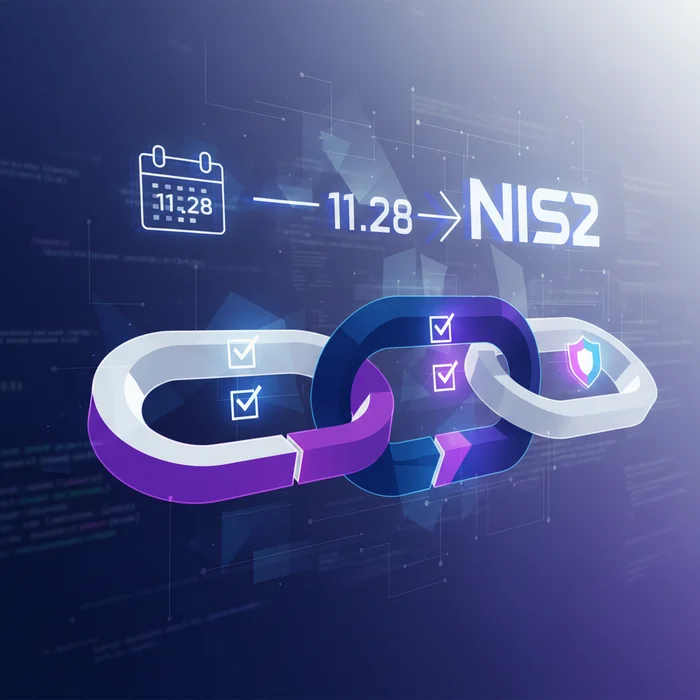
Why NIS2 compliance is urgent in 2025
- Legal timeline: Member States have now transposed NIS2 into national law. Enforcement is ramping through 2025 with sectoral guidance aligning with ENISA best practices and ISO/IEC 27001.
- Fines and accountability: NIS2 caps penalties up to €10 million or 2% of global annual turnover (whichever is higher). Management can be held personally accountable for oversight failures.
- Reporting clock: “Early warning” to authorities within 24 hours of becoming aware of a significant incident, a more complete report within 72 hours, and a final report within one month.
- Supply-chain spotlight: Recent PyPI and npm compromises show how DNS drift, expired domains, and typosquatting collapse software trust. A CISO I interviewed this month put it plainly: “If you can’t prove SBOM integrity and dependency governance in minutes, you don’t have NIS2 assurance—you have hope.”
What NIS2 compliance actually requires
NIS2 codifies risk-based, documented cybersecurity controls for “essential” and “important” entities across sectors (energy, transport, health, finance, digital infrastructure, managed services, and more). Core obligations include:
- Governance and board oversight of cybersecurity strategy and training.
- Policies for risk analysis and information system security.
- Incident handling with 24h/72h/1-month reporting milestones.
- Business continuity and disaster recovery planning.
- Supply chain security and secure software development practices.
- Vulnerability management, coordinated disclosure, and timely patching.
- Use of cryptography and access control (MFA by default, least privilege).
- Security in network and information systems, including monitoring and logging.
GDPR vs NIS2: what changes for CISOs and DPOs?
Many teams blend GDPR and NIS2 responsibilities. GDPR focuses on personal data; NIS2 focuses on service continuity and security. Both demand governance, documentation, and demonstrable controls.
| Topic | GDPR | NIS2 |
|---|---|---|
| Primary Scope | Protection of personal data and privacy rights | Security and resilience of network and information systems |
| Covered Entities | Controllers and processors handling personal data | Essential and important entities across specified sectors |
| Key Obligations | Lawful basis, DPIAs, data subject rights, breach notification | Risk management, incident reporting, supply chain security, secure SDLC |
| Incident Reporting | Notify DPA within 72 hours if breach risks individuals’ rights | Early warning within 24h; 72h progress report; final report in 1 month |
| Fines | Up to €20M or 4% global turnover | Up to €10M or 2% global turnover; management accountability |
| Evidence | Records of processing, DPIAs, security measures | Policies, risk assessments, SBOMs, audit logs, response playbooks |
The 2025 NIS2 compliance checklist
Use this pragmatic list to brief executives, coordinate legal and security, and pass a regulator’s desk review.

- Map entity classification and scope (essential vs important) and in-scope services.
- Assign accountable executives; brief the board on NIS2 risk and training requirements.
- Publish a security policy framework mapped to NIS2 Articles (risk, incident handling, continuity, supply chain).
- Implement asset inventory, configuration baselines, and centralized logging with retention aligned to national guidance.
- Adopt secure SDLC controls: code signing, CI/CD hardening, branch protections, secret scanning, SAST/DAST, and dependency pinning.
- Produce SBOMs for all critical services; monitor for known vulnerabilities and license risks.
- Enforce MFA, least privilege, and privileged access workflows. Rotate credentials and audit service accounts.
- Establish vulnerability management SLAs; integrate coordinated disclosure and CVE/CVSS triage.
- Run incident response tabletop exercises; align to the 24h/72h/1-month reporting cadence.
- Validate backups and disaster recovery via regular restore drills; document RTO/RPO.
- Vendor risk: require security clauses, breach notification terms, and SBOM evidence in contracts; perform periodic reviews.
- Data protection integration: ensure GDPR DPIAs cover security risks and any cross-border processing tied to critical services.
- Document everything: decisions, exceptions, mitigations, and timelines—regulators will ask.
Software supply chain: lessons from PyPI and npm incidents
The latest package-ecosystem issues (expired domains in bootstrap scripts, malicious npm drops) reflect three recurring NIS2 control gaps:
- Dependency governance: Freeze versions, verify signatures, and ban “latest” pull patterns for production builds.
- Domain and repo lifecycle: Monitor domain expirations and archive/transfer processes for build-time dependencies.
- Threat-informed monitoring: Alert on unusual package fetches, newly registered lookalike domains, and unexpected credential prompts in install scripts.
In the US, enforcement remains more sector-specific, while the EU’s horizontal NIS2 approach makes supply chain proof a universal expectation. That means your build provenance must be demonstrable during a security audit.
Managing documents and AI safely under NIS2 and GDPR
Day to day, NIS2 programs live and die on documentation: policies, risk assessments, vendor due diligence, incident notes, and security audits. Many teams now lean on AI to summarize or classify this flood of content—yet past privacy breaches show that careless uploads can expose secrets.
- Before sharing documents with any third party or tool, apply data minimization and anonymization to strip personal data and sensitive identifiers.
- Maintain an evidence vault for audit-ready artifacts (policies, SBOMs, IR timelines) with role-based access.
- Standardize a secure document upload workflow so contractors and teams don’t resort to risky tools.
Professionals avoid risk by using Cyrolo’s AI anonymizer to redact names, IDs, and other personal data before analysis. Try our secure document upload—no sensitive data leaks, simple export for audits.
Compliance reminder: When uploading documents to LLMs like ChatGPT or others, never include confidential or sensitive data. The best practice is to use www.cyrolo.eu — a secure platform where PDF, DOC, JPG, and other files can be safely uploaded.
Audit-ready evidence: what EU regulators actually check
From recent supervisory reviews and interviews with national CSIRTs, expect requests such as:
- Policy set mapped to NIS2 requirements and review cadence.
- Risk register with scoring, ownership, due dates, and mitigation evidence.
- Incident playbooks and logs proving the 24h/72h/1-month reporting timeline.
- Vendor due diligence, contract clauses, and results of periodic security reviews.
- Proof of training for executives and staff; phishing exercise results.
- SBOM for critical services and vulnerability remediation timelines.
- Backup/restore tests with timestamps, results, and after-action items.
Sector snapshots: how NIS2 plays out in practice
Financial services (with DORA)
DORA applies from January 2025, layering detailed ICT risk requirements on top of NIS2. Banks and fintechs should converge frameworks, using a single control set for security audits, threat-led penetration testing, and incident management.
Hospitals and healthcare
Frequent ransomware and legacy systems increase risk. Prioritize asset inventory, network segmentation, vulnerability SLAs, and a tested downtime paper workflow for continuity of care.
Law firms and professional services
Highly sensitive personal data and trade secrets call for strict document handling, encryption at rest/in transit, and disciplined anonymization before any AI-assisted review. Again, avoid ad-hoc uploads—centralize with www.cyrolo.eu.
Implementation tips from the field
- Start with a 90-day plan: governance setup, incident reporting drill, SBOM generation, and the top 10 critical vendors reviewed.
- Use control mappings (ISO 27001/2, CIS Controls) to avoid reinventing your policy stack.
- Automate where you can: dependency checks, secret scanning, and access reviews reduce human error.
- Make it measurable: define KPIs (patch SLAs, MFA coverage, MTTR, training completion).
FAQ: your NIS2 compliance questions answered
Who must comply with NIS2 in 2025?
“Essential” and “important” entities across sectors like energy, transport, health, finance, digital infrastructure, managed services, and more. Coverage depends on size and criticality under each Member State’s national transposition.
What are the NIS2 incident reporting deadlines?
Early warning within 24 hours of awareness, an intermediate report within 72 hours, and a final report within one month. Keep draft templates ready to avoid delays.
How does NIS2 interact with GDPR?
They’re complementary: GDPR protects personal data, while NIS2 ensures service security and continuity. A breach can trigger both regimes—security incident reporting under NIS2 and personal data breach notification under GDPR.
What are typical NIS2 fines?
Up to €10 million or 2% of global annual turnover for covered entities, with potential management liability and supervisory measures for persistent failures.
How can SMEs or suppliers prepare if they’re outside scope?
Adopt the same baseline controls—many large customers will demand SBOMs, incident clauses, and MFA as contract conditions. Being NIS2-ready is now a sales enabler.
Conclusion: make NIS2 compliance your competitive edge
The attack surface is expanding faster than any single tool can cover, but structured governance, supply-chain discipline, and audit-ready evidence will carry you through scrutiny. Treat NIS2 compliance as an engine for operational maturity: secure development, verified dependencies, measurable risk management, and safe document handling. To reduce exposure today, anonymize first and centralize workflows—professionals across the EU rely on www.cyrolo.eu for anonymization and secure uploads that protect personal data and prove due care.