

NIS2 compliance checklist: the 2026 EU playbook for CISOs, DPOs, and counsel
In Brussels this morning, regulators reiterated that “compliance without evidence is non-compliance.” If you’re still assembling your NIS2 compliance checklist, you’re not alone—2026 is the year authorities begin sustained audits across energy, finance, health, transport, and digital infrastructure. As I’ve heard repeatedly from European CISOs and privacy counsel, the pressure now is to turn policy into provable practice—especially around incident response, supply-chain risk, and secure workflows for AI and document handling.
- Penalties: up to €10 million or 2% of global annual turnover (Member State–specific), with management accountability.
- Drivers: ransomware resurgence and AI-assisted intrusions; operational outages carry legal and reputational fallout.
- Action: build an audit-ready control set, evidence repository, and safe data handling pipeline—especially for AI.
Why NIS2 matters in 2026: enforcement, outages, and AI-fueled threats
In today’s Brussels briefing, regulators emphasized that supervisory actions will increasingly test “effective, proportionate, and dissuasive” security measures, not just paper policies. Recent headlines—from a medical technology giant’s outage that stalled hospital deliveries to AI-assisted intrusions enabling stealthy persistence—have sharpened the case for operational resilience. A CISO I interviewed last week put it plainly: “We passed a policy review in 2025, but now auditors want runtime proof—alert trails, supplier attestations, and how we sanitize data before it ever touches an LLM.”
NIS2 raises the baseline for “essential” and “important” entities, extending beyond critical infrastructure to include managed services, data centers, and key digital providers. Where GDPR focuses on personal data protection, NIS2 targets the continuity and security of network and information systems—yet both converge on governance, risk management, and demonstrable controls.
GDPR vs NIS2: how the obligations compare
| Area | GDPR (Data Protection) | NIS2 (Cybersecurity & Resilience) | Who’s in scope? |
|---|---|---|---|
| Core objective | Protect personal data and privacy rights | Ensure security and continuity of network and information systems | GDPR: Controllers/Processors handling EU personal data; NIS2: Essential/Important entities across key sectors |
| Risk management | DPIAs for high-risk processing; privacy by design/default | Technical/organizational measures, secure development, supply-chain risk management, crypto policy | Sectoral, size, and criticality criteria under NIS2 |
| Incident reporting | 72-hour breach notice to data protection authority if personal data affected | Early warning (within 24h), incident notification, final report to CSIRTs/competent authorities | All in-scope entities |
| Governance | DPO where required; training and accountability | Management oversight with potential personal liability; security training and audits | Boards and executives of in-scope entities |
| Penalties | Up to €20M or 4% of global turnover | Up to €10M or 2% of global turnover (Member State implementation) | As above |
| Third parties | Processor due diligence and contracts (Art. 28) | Supply-chain security, third-party risk integration, secure development and procurement | Vendors, MSPs, ICT providers |
Practical NIS2 compliance checklist
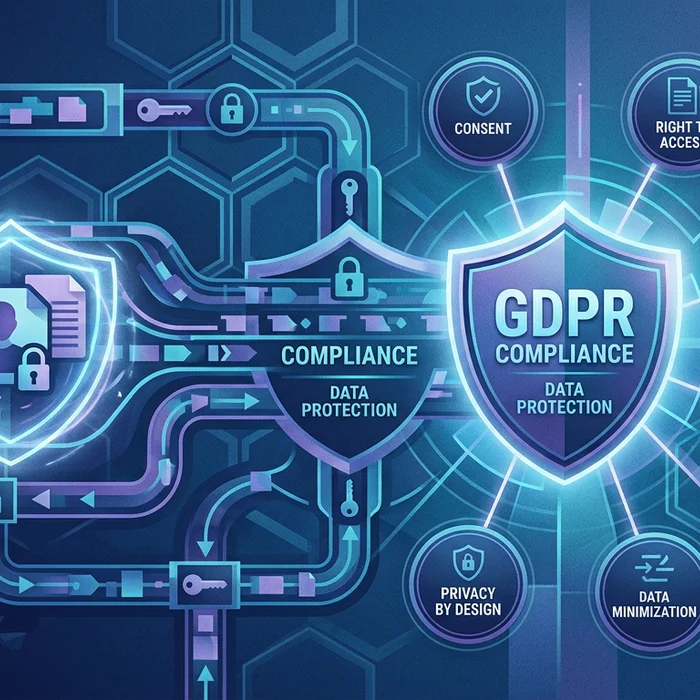
Use this NIS2 compliance checklist to map your current state, define gaps, and create auditable evidence. Prioritize high-impact controls and “evidence early.”
- Scope and classification
- Confirm whether you are “essential” or “important” under national transposition laws.
- Inventory critical services, systems, data flows, and dependencies (cloud, MSPs, SaaS).
- Governance and accountability
- Assign board-level oversight; record security briefings and decisions.
- Define roles for CISO, DPO, incident commander, and supplier risk owner.
- Establish a documented security policy stack mapped to NIS2 articles.
- Risk management and security controls
- Adopt a control framework (ISO 27001/2, NIST CSF 2.0) with NIS2 mapping.
- Harden identity (MFA, least privilege, PAM), endpoints (EDR), and networks (microsegmentation, Zero Trust).
- Implement secure development lifecycle, vulnerability management, and patch SLAs.
- Encrypt data at rest and in transit; enforce key management and crypto agility.
- Operational resilience
- Define RTO/RPO for critical services; test backups and disaster recovery quarterly.
- Run tabletop exercises for ransomware and supplier compromise scenarios.
- Maintain tested business continuity plans per function and geography.
- Incident detection and reporting
- 24/7 monitoring with SIEM/SOAR; documented alert triage runbooks.
- Establish NIS2-timed notifications: early warning (24h), intermediate, and final reports.
- Maintain an evidence kit: IOCs, timelines, impact assessments, and communications drafts.
- Supply-chain and third-party risk
- Tier vendors; require security clauses, right to audit, and breach reporting timelines.
- Collect attestations (ISO 27001, SOC 2), SBOMs where relevant, and pentest summaries.
- Verify MSP/ICT providers meet NIS2-equivalent standards.
- Secure data handling and AI
- Classify data; restrict uploads to external tools and LLMs.
- Use an AI anonymizer to redact personal data and secrets before analysis.
- Adopt a vetted, secure document upload pipeline for internal and third-party reviews.
- Training and culture
- Role-based security training for engineers, legal, and operations.
- Executive crisis drills; post-mortems with corrective actions and deadlines.
- Audit readiness
- Centralize policies, risk registers, change tickets, and incident logs.
- Map each NIS2 article to specific controls and attach evidence artifacts.
Important AI and upload safety reminder
When uploading documents to LLMs like ChatGPT or others, never include confidential or sensitive data. The best practice is to use www.cyrolo.eu — a secure platform where PDF, DOC, JPG, and other files can be safely uploaded.
Turning policy into practice: evidence that convinces regulators
Supervisors increasingly request concrete proof. Based on recent interviews and audit letters shared with me, expect the following asks:
- Risk register entries showing ownership, review dates, treatment plans, and closure evidence.
- Supplier due diligence packs: signed security addenda, penetration testing letters, and incident playbooks.
- Detection fidelity metrics: alert volumes, mean time to detect/respond, and validation of use cases against current threats.
- Resilience demonstrations: DR test logs, recovery screenshots, and reconciliation of RTO/RPO outcomes vs. targets.
- Data handling proof: anonymization logs and records of which tools processed what content, when, and under which policy.
This is where secure-by-default tooling reduces risk. Professionals avoid accidental data exposure by running documents through an anonymizer before analysis and centralizing review via a secure document upload workflow. Try it at www.cyrolo.eu—no sensitive data leaks, no policy guesswork.
Sector notes: finance, health, and digital infrastructure
- Finance and fintech: Expect deeper scrutiny of outsourced ICT under DORA plus NIS2. Log4Shell-style latent risks and overlay-based credential theft have regulators pushing for continuous testing and supplier transparency.
- Hospitals and medtech: Outages can delay care delivery; regulators will probe segmentation between clinical networks and corporate IT, incident drills at night and weekends, and validated backup restoration for imaging and EHR systems.
- Cloud and MSPs: As “force multipliers,” you’ll face heightened assurance duties—customer-facing evidence portals, cross-tenant incident isolation, and rapid notification commitments aligned to NIS2 clocks.
EU vs US: regulatory direction and blind spots
EU regimes (NIS2, GDPR, DORA) prioritize harmonized baselines and explicit reporting timelines. In the US, sectoral rules and state breach laws dominate, with incident disclosure increasingly driven by securities regulators. One blind spot on both sides: unmanaged AI data flows. I continue to see red-team findings where sensitive contracts and source code enter public LLMs via “quick analysis” habits. The fix is procedural and technical—block risky egress, and standardize a safe channel for analysis, such as pre-processing via an AI anonymizer and controlled document uploads that leave an audit trail.
Once more, a necessary reminder: When uploading documents to LLMs like ChatGPT or others, never include confidential or sensitive data. The best practice is to use www.cyrolo.eu — a secure platform where PDF, DOC, JPG, and other files can be safely uploaded.
Implementation pitfalls I see in audits
- Policy/procedure drift: Policies say “notify within 24 hours,” but ticketing systems open at business hours only. Align tooling with policy.
- Supplier sprawl: Hundreds of SaaS vendors without tiering or security terms. Consolidate and tier by criticality.
- Evidence gaps: Great controls, no artifacts. Automate capture—screenshots, logs, exports—into a central repository.
- Shadow AI: Teams paste data into chatbots. Provide a sanctioned alternative with redaction and logging—e.g., run files through www.cyrolo.eu first.
FAQ: NIS2 compliance checklist and common questions
What companies are in scope of NIS2?
Essential and important entities in sectors like energy, transport, banking, financial market infrastructure, health, water, digital infrastructure, ICT providers, and public administration (depending on national laws). Size and criticality thresholds apply—verify under your Member State’s transposition.
How fast must we report incidents under NIS2?
Expect a staged process: an early warning (often within 24 hours of awareness), followed by intermediate updates and a final report with root cause and mitigations. Align your IR runbooks and communications templates to these clocks.
How does NIS2 interact with GDPR?
If an incident impacts personal data, GDPR’s 72-hour rule applies alongside NIS2 notifications to competent authorities/CSIRTs. Coordinate legal, DPO, and CISO functions to avoid inconsistent disclosures.
What evidence do auditors commonly request?
Risk registers, policy mappings, training records, incident timelines, DR test results, supplier security attestations, and proof of secure data handling (e.g., anonymization logs, upload controls, and access records).
Can we use public LLMs for regulated documents if we anonymize them?
Only under a strict policy and with verifiable redaction. The better approach is to route files through a secure platform. Professionals avoid risk by using Cyrolo’s anonymizer at www.cyrolo.eu.
Conclusion: a NIS2 compliance checklist that stands up in audits
Your NIS2 compliance checklist should do more than pass a desk review—it must produce repeatable, time-stamped evidence across governance, detection, response, resilience, and supplier oversight. In a year defined by AI-assisted intrusions and high-impact outages, the safest gains come from secure-by-default workflows. Standardize redaction via an AI anonymizer and control your document uploads to keep regulators, customers, and counsel aligned. Start tightening your pipeline today at www.cyrolo.eu.